As the CCJ transitions to a
model better geared to leverage social networks, we are
moving away from our past use of email notification
services. If you would like to be added to our internal
email distribution, please send your request to
Rick@RARWRITER.com.
You can also follow us on
Facebook and
Twitter, which we will use to keep you notified of new
features and news articles.
ABOUT RAR: For those of
you new to this site, "RAR" is Rick Alan Rice, the publisher
of the RARWRITER Publishing Group websites.
Use this link to visit the
RAR music page, which features original music
compositions and other.
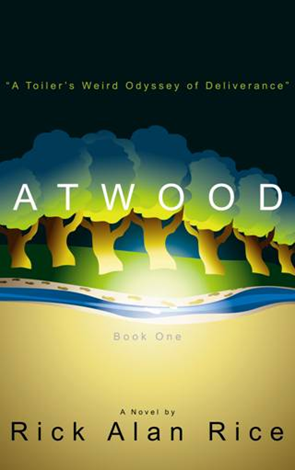
ATWOOD - "A Toiler's Weird Odyssey of Deliverance"-AVAILABLE
NOW FOR KINDLE (INCLUDING KINDLE COMPUTER APPS) FROM
AMAZON.COM.Use
this link.
CCJ Publisher Rick Alan Rice dissects
the building of America in a trilogy of novels
collectively called ATWOOD. Book One explores
the development of the American West through the
lens of public policy, land planning, municipal
development, and governance as it played out in one
of the new counties of Kansas in the latter half of
the 19th Century. The novel focuses on the religious
and cultural traditions that imbued the American
Midwest with a special character that continues to
have a profound effect on American politics to this
day. Book One creates an understanding about
America's cultural foundations that is further
explored in books two and three that further trace
the historical-cultural-spiritual development of one
isolated county on the Great Plains that stands as
an icon in the development of a certain brand of
American character. That's the serious stuff viewed
from high altitude. The story itself gets down and
dirty with the supernatural, which inATWOOD
- A Toiler's Weird Odyssey of Deliverance is the
outfall of misfires in human interactions, from the
monumental to the sublime.The
book features the epic poem"The
Toiler"as
well as artwork by New Mexico artist Richard
Padilla.
Elmore Leonard
Meets Larry McMurtry
Western Crime
Novel
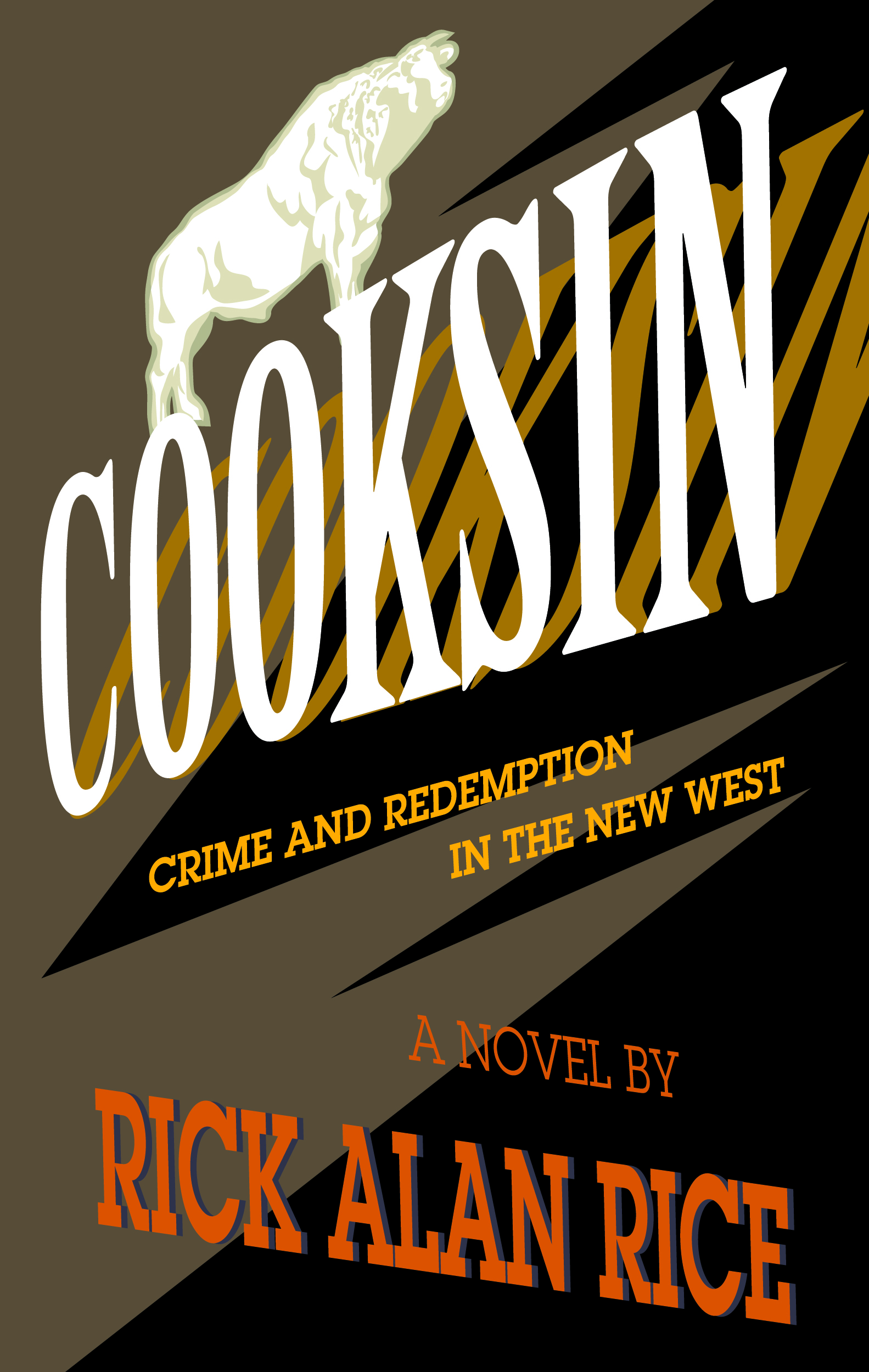
I am offering another
novel through Amazon's Kindle Direct Publishing service.
Cooksin is the story of a criminal syndicate that sets its
sights on a ranching/farming community in Weld County, Colorado,
1950. The perpetrators of the criminal enterprise steal farm
equipment, slaughter cattle, and rob the personal property of
individuals whose assets have been inventoried in advance and
distributed through a vast system of illegal commerce.
It is a ripping good yarn, filled
with suspense and intrigue. This was designed intentionally to
pay homage to the type of creative works being produced in 1950,
when the story is set. Richard Padilla
has done his usually brilliant work in capturing the look and feel of
a certain type of crime fiction being produced in that era. The
whole thing has the feel of those black & white films you see on
Turner Movie Classics, and the writing will remind you a little
of Elmore Leonard, whose earliest works were westerns.
Use this link.
EXPLORE THE KINDLE
BOOK LIBRARY
If you have not explored the books
available from Amazon.com's Kindle Publishing
division you would do yourself a favor to do so. You
will find classic literature there, as well as tons
of privately published books of every kind. A lot of
it is awful, like a lot of traditionally published
books are awful, but some are truly classics. You
can get the entire collection of Shakespeare's works
for two bucks.
Amazon is the largest,
but far from the only digital publisher. You can
find similar treasure troves at
NOOK
Press(the
Barnes & Noble site),Lulu,
and others.
ARTIST NEWS
Manipulating Culture
It
has been four years since alternative media journalist Dave McGowan
published Weird Scenes Inside the Canyon: Laurel Canyon, Covert Ops &
the Dark Heart of the Hippie Dream. It didn't exactly set the
publishing world on fire when it came out, and it isn't exactly doing that
now, but it hangs around and slowly gains ground with conspiracy buffs.
McGowan is an amateur investigator, and a writer
without formal education, whose previous interest in weird stories had been mostly
around UFOs. But then he came upon this odd statistical anomaly.
He started looking into the development
of the 1960s music scene, with many venues centered in West Hollywood, as described in the story on
the right (Nancy's Great Hangover), and he started looking into the
family backgrounds of the people involved. Laurel Canyon was populated
with young creative types, who played the clubs along the Sunset Strip
and moved still-new Rock'n Roll into a rapidly developing swirl of
musical styles, from the jangle rock of The Byrds, through the surreal
brooding of The Doors, the progressive rock of Frank Zappa, and the
country rock of Buffalo Springfield. Linda Ronstadt, Joni Mitchell, Neil
Young, The Mamas and the Papas, and many other legends-in-the-making came
out of that single musical scene. Many resided in the rugged and leafy
Laurel Canyon, just minutes from what in the late 1960s was America's
cultural center.
McGowan determined that many of those
young people, who became enormously successful and influential in
American musical culture, were the children of CIA and military
families. And he further determined that may have been influenced to be
in Laurel Canyon in the first place because there was a Top Secret CIA
research facility there. (That property was recently purchased by
musician and Oscar-winning actor Jared Leto.)
Exhibit 1, in McGowan's conspiracy
framework, is Jim Morrison, the front man of The Doors, who named his
band after LSD pioneer Aldous Huxley's book The Doors of Perception.
Morrison was the son of the admiral who had been in charge of the fleet patrolling
the Gulf of Tonkin. An incident there, which conspiracy buffs believe to
have been a false flag operation, was the trigger that dragged the U.S
into the quagmire of the Viet Nam War. It is ironic that the Lizard
King, an avatar of anti-establishment convention, was the progeny of a
man complicit in sending his son's generation to war.
It only begins there. Laurel Canyon had
influential salon keepers, most notably Frank Zappa and David Crosby.
Frank Zappa grew up in Baltimore, Maryland, near Edgewood Arsenal, where
his father, who had top security clearance, was a chemical warfare
specialist. Zappa somehow got unusual attention early on, even showing up on
Steve Allen's Tonight Show playing the bicycle as a musical instrument.
He represented counter-culture, but listen to any Zappa interview and you'll see
his inclinations were not what one might expect. He was a pro-military
arch conservative.
Zappa took over a commune known at the
time as "The Tree House" that served as a crash pad where the famous
bedded down with runaways and others from the area's active street life.
According to McGowan, attendees over time included Mick Jagger Marianne
Faithfull, members of the Animals, Mark Lindsay from Paul Revere and the
Raiders, Alice Cooper who joined Zappa’s Mothers of Invention, Janis
Joplin, and Roger McGuinn and Mike Clarke from the Byrds. LSD guru
Timothy Leary was there, according to reports, as were George Harrison
and Ravi Shankar.
David Crosby's soirees are legendary -
the kind that only a trust fund kid could host.
David Van Cortlandt Crosby is the progeny
of American aristocrats from the Van Cortlandt and Van Rensselaer
families. Van Ressselaers founded the Dutch West Indies Company, and
since the 1600s have held positions of prominence in all aspects of
American governance and military leadership. Ditto the Van Cortlandts.
That means that Crosby's ancestors were closely associated with the African
slave trade.
In McGowan's thesis, Laurel Canyon in the
late 1960s was a place of avant garde salons, charismatic charlatans
(including Charles Manson)
with secretive agendas, and LSD. Central to the premise was the savant
Owsley Stanley, who is notable as the largest private producer of LSD in
history. Stanley had become involved in LSD research being done at St.
Elizabeth’s Hospital in Washington DC. He wasn't a researcher, but
rather a 15-year old test subject in the CIA's MK-Ultra program.
Stanley was something of a genius, who
eventually came to California to work at Jack Parson's Jet Propulsion Labs (JPL).
That cutting edge research facility was led by a founder with
connections to Scientology founder L. Ron Hubbard, Church of Satan
founder Anton Lavay, and the infamous occultist Aleister Crowley.
Crowley allegedly documented the first encounter with a Grey alien, if
that's what the entity Lam was, which was conjured up through Crowley's
Ordo Templi Orientis (OTO) rituals. Parson's was allegedly the first to
encounter the Nordic alien race.
Owsley Stanley became the soundman for
the Grateful Dead, which in the conspiracy world was a band whose reason
for being was to encourage the creation of a "Hippie Movement" to
protest the War in Viet Nam. The idea was that the CIA used all of
the well-placed, well-resourced Laurel Canyon people to create a Hippie
icon, a type of straw
man so ineffectual and ridiculous that they would undermine the anti-war
movement.
If that was the goal, it may not have
worked. Timothy Leary inveighed the
troops to "Turn on, tune in, drop out" for the purpose of creating an
army of "Dead Heads". Many historians would argue that
anti-war demonstrations eventually made continuance of the War in Viet
Nam impossible.
That only touches upon McGowan's
treatise, which presents a raft of other Laurel County celebrities with
connections to military intelligence and defense industry groups. My
guess is that there is probably some truth to all of it, no absolute
truth to any. As a child of
that era, I know that messages were sent and received that stayed with
segments of the Baby Boomer population for decades, and resonate to this
day.
Here is an interview with McGowan that
won't convince you that anything he says is real, but at least gives him
the opportunity to use his words.-RAR
Nancy's Great Hangover
One
of my favorite websites is The Great Hollywood Hangover (click
here), which was launched way back in the year 2000. It is truly
great for all kinds of reasons, including that it is a beautiful
dinosaur from an early age of personal websites. The primitive level of
its design and technology seems perfectly aligned with the authenticity
of its purpose, which is to commemorate a wonderful time from long ago -
West Hollywood in the late 1960s.
The Hollywood that is being remembered is
that which existed along that section of Sunset Boulevard sandwiched
between between Beverly Hills and Hollywood proper. The area initially
lay outside the corporate boundary of Hollywood, which exempted it from
certain legal restrictions, and so it became a hotbed of sub-culture
activity. In the 1920s, it was a place where prohibition was violated,
and organized crime moved in. They opened night clubs and gambling
casinos, and later high profile clubs (Ciro's, the Mocambo, the
Trocadero). It was an area where movie people hung out. The storied
Chateau Marmont is at its eastern border. Movie people started to avoid
the place as it became a tourist destination, but in the '60s it also
became a counter-culture magnet, with venues like the Whiskey A-GoGo and
The Roxy hosting The Doors, The Byrds, Buffalo Springfield, and every
other L.A. band you can think of from that era. And it was special, at
least through the eyes of Nancy Deedrick, who was witness and
participant to American cultural history.
Deedrick (pictured above, center-right,
with her sister Dixie) was an exotic dancer who arrived in West
Hollywood, with a sister, about the time The Doors broke into stardom.
They were playing at a dive called London Fog on the Strip, but were
about to hit the big time. Nancy, who went by the stage name Nancy
Seaman, was on her way to becoming the Strip's first dancer to go fully
nude. It made her somewhat famous, though she drew plenty of attention
since arriving in town with a Groupies nameplate in the back window of
her car. Even as an exotic dancer, she entered topless contests and won
amateur titles. The Tonight Show became interested in her, but Nancy was
conflicted. Her parents back home would not have understood that her
life in L.A. was all good fun and good spirits.
Nancy knew everyone, dating the legends
of rock. It all left her a little shell-shocked, according to her own
extraordinarily honest site. She gave up stripping in the 1970s and
moved to Nashville to become a singer-songwriter, surviving for two
decades on dreams that didn't work out. She spiraled into emotional and
mental problems, all part of what she eventually called "the Great
Hollywood Hangover". And then somehow she exorcised her demons and
committed to letting others know that they could do it, too.
I was not around to know Nancy Deedrick,
though I would come to know people who knew her in those West Hollywood
days. She eventually had three children and emerged out of the back end
of her long, dark, post-Hollywood period, but with her website she
contributed greatly to the documentation of an important time and place
in time. And she reaffirmed the notion that young people can be wild and
crazy, and leave wonderful memories, which will help when the bills for
living a life finally come due.- RAR
Travis Fullerton
That is Travis Fullerton, pictured
center in this clipped photograph of Sylvester and the Hot Band, from
back in the day. Starting in San Francisco, from 1966 to 1980, Fullerton
played drums for bands ranging from Sam the Sham to Graham Nash. He was
around during the heyday of West Hollywood Rock, as described by Nancy
Deedrick, and we had a mutual friend, the late Buddy Zoloth, who
was known to many readers of this site. One of the joys of the late
Nancy Deedrick's The Great Hollywood Hangover is using her home page
search tool to find people you know. I found Buddy Zoloth, and I found
the excerpt below from Fullerton, which is the finest summary I have
ever read of our late friend's life.
Some comments about our
good friend Buddy Zoloth......I met him when he came out to LA from
Florida with Blues Image. I think it was 1970 and after playing around
town, they quickly became the house band for Marshall Brevitz's club,
Thee Experience, on Sunset. Buddy earned Marshall's trust, managed the
bar, then the entire club. By that time, BI had a big hit on their hands
with "Ride Captain Ride". I played with various bands at Thee Experience
when I met Buddy. His intelligence was one of the first things I noticed
about him. His mind worked at a higher "clockrate" than folks around
him....he was always three steps ahead in those days. He loved people,
he was a great communicator, and boy, did he had fun doing it! So, in
the days of English roadies (being the cream of the crop), Buddy was one
of the handful of American roadies, that were also experts at their
craft. He went on to manage Marshall's new club, Thee Club, but by that
time the call of the road was summoning Buddy. After a short stint with
Rita Coolidge & Graham Nash's fine band (sorry, I couldn't resist), he
joined Stephen Stills with his best friend, Joe Lala. Along with the
great keyboardist, Jerry Aiello.......Joe, Buddy, and Jerry became an
inseparable trio for years in Hollywood. Buddy and Joe went on to work
with Stephen and then Crosby, Stills, Nash and Young in their various
forms. Years later he was captain of a sloop, based out of Amsterdam,
and worked and lived in the Virgin Islands for a while. One year ago,
Buddy came to see me and take a little trip on our boat in the Seattle
area. We hadn't seen each other for over 20 years, so we had a lot of
catching up to do. It was great fun to reminisce although he was greatly
weakened by the growing tumor in his kidney. His spirit, curiosity,
humor, and intelligence was still evident. A month before he passed away
on June 10th, I sent him a mail about some opportunity and he responded
with "what have I not done in my life? I've done it all." It's true,
Buddy lived the life folks dream about! Those of us lucky enough to have
shared the "dream life" with him, will remember him fondly.
WDIA in Memphis is typically cited as the first
radio station in the United States to target its playlist to the
"African American" market, though in 1949, when a young B.B. King got an
on-air talent job there, it was likely not referenced that way. There
was a time when music, via the radio, pushed societal change in the way
that GitHub pushes code and technological change today. It is hard to
imagine, in our present-day age of media fracture, but there was once a
time when a pirate radio voice could move mountains and make history. It
happened with WDIA, and on another cultural front it happened across
America through XERF-AM, which was broadcast from Ciudad Acuña in Mexico
in covered the entire United States. It introduced most of America to
Wolfman Jack, and in many ways created a Rock'n Roll radio culture that
shaped subsequent generations of people around the world. Radio was once
something really special.
Such is the story of Capital Radio 604, a pirate
radio station in South Africa that has become the subject of a
documentary looking for development and distribution help. Check out the
trailer below, which does an excellent job of setting up the story.
Until 1991, South Africa was a country in which majority Black
populations were restricted to autonomously ruled ghetto regions that
kept them apart from one another, and out of the daily lives of the
ruling White population. Then an enterprising group of rebels, with the
help of the U.K.'s Capital Radio network, and charity sponsor Richard
Attenborough CBE, used Apartheid's own restrictions against it,
mounting a powerful radio transmitter on land the government couldn't
touch. They played the music the government had banned: The Police, Dire
Straits, and other stuff that was mainstream fare in most of the world
but outlaw thought in South Africa. And they broadcast the political
truth of South Africa to the world via short wave radio transmissions.
Capital Radio 604 worked, and it is inspiring to
watch this trailer and learn of their story. - RAR
The CCJ at RARWRITER provides a steady stream of news
feeds from a variety of sources. Use this link to visit the
Music News page.
SEARCH CCJ CONTENT
Looking for something in the RARWRITER.com
archives? Type the item you wish to find in the custom search
field below, then click on the magnifying glass to see a list of
previously published articles relevant to your query.
Rob Beck, a writer for
Beginner Guitar HQ, put together this insightful guide on
selecting a digital piano or keyboard.
Use this
link or click on the photo above to go to
How to Choose a Digital Piano
– 10 Factors to Consider According to Science


 It
has been four years since alternative media journalist Dave McGowan
published Weird Scenes Inside the Canyon: Laurel Canyon, Covert Ops &
the Dark Heart of the Hippie Dream. It didn't exactly set the
publishing world on fire when it came out, and it isn't exactly doing that
now, but it hangs around and slowly gains ground with conspiracy buffs.
It
has been four years since alternative media journalist Dave McGowan
published Weird Scenes Inside the Canyon: Laurel Canyon, Covert Ops &
the Dark Heart of the Hippie Dream. It didn't exactly set the
publishing world on fire when it came out, and it isn't exactly doing that
now, but it hangs around and slowly gains ground with conspiracy buffs. One
of my favorite websites is The Great Hollywood Hangover (
One
of my favorite websites is The Great Hollywood Hangover (


