--------------------"The best source on the web for what's real in arts and entertainment" ---------------------------
Volume 1-2016
MUSIC BOOKS FINE ARTS FILM THE WORLD
|
ARTIST NEWS THIS EDITION ABOUT MUSIC MUSIC REVIEWS BOOKS CINEMA FASHION FINE ARTS FEATURES SERIES MEDIA ESSAY RESOURCES WRITTEN ARTS POETRY CONTACT ARCHIVES MUSIC LINKS |
|---|
|
The Blues Series
First Published October 2009 Edition
|
|||||||||||||
|
NOTE:
Click on the panel above or on this link to go to
Koko Taylor's
website.
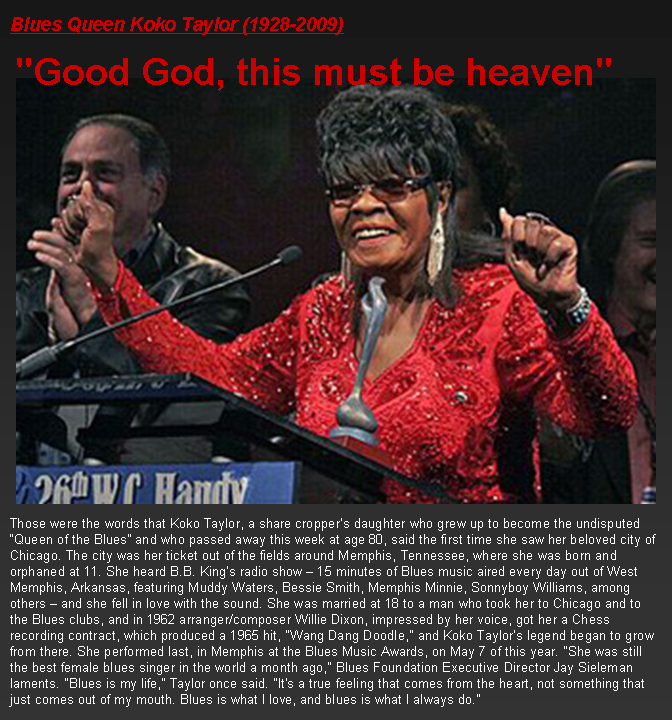
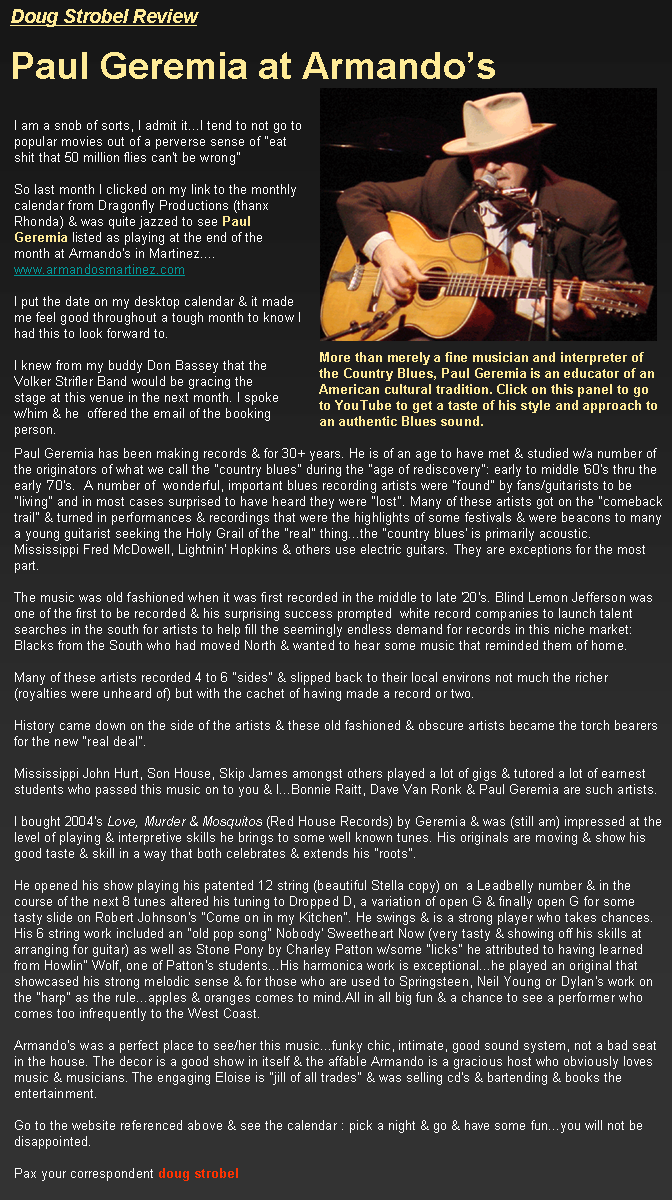
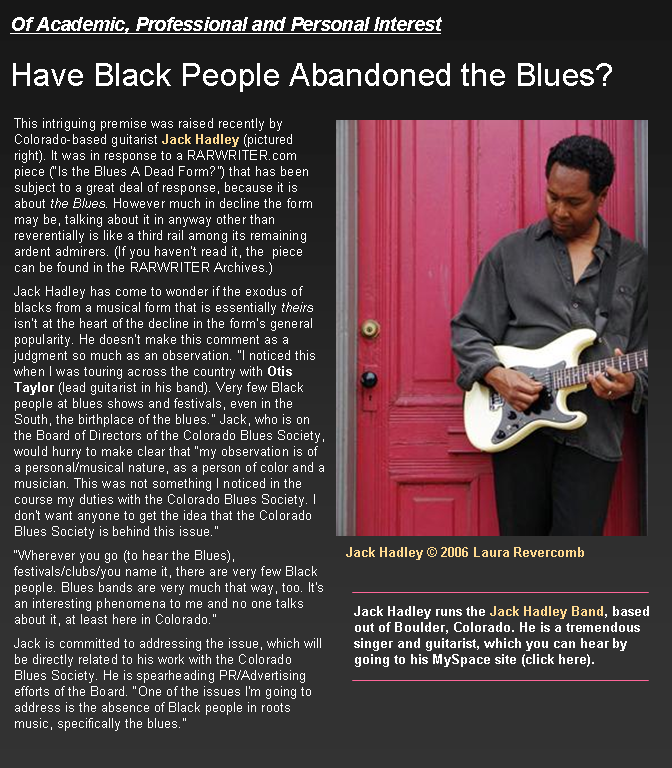
The passing this week of Koko Taylor puts the series that RARWRITER.com has been running on the Blues in a special context. Click here to go to the story in this column below on musician and keen cultural observer Jack Hadley's observation on the state of Blues music and the extent to which Black musicians and fans of the Blues have either accepted or ignored this most American of musical forms. Click here to go to the article on the cancellation of this year's San Francisco Blues Festival, which began the series, . For more on the Blues - the Country Blues, to be specific - check out the story below, Doug Strobel's review of Paul Geremia at Armando's.
|
|
FOLLOW UP NOTE: There is a grievous error of omission in the way the story above on Jack Hadley is presented. It has to do with his observation that Blues music is not attracting enough attention from the Black community to maintain the health of this musical form, indigenous to the southern United States, and a true cultural treasure. Wrote Jack - "I did notice in the next-to-last paragraph '...It happens that Jack observed this phenomenon in the course of his duties with the Blues Society..' The reality is that I noticed this when I was touring across the country with Otis Taylor (lead guitarist in his band). Very few Black people at blues shows and festivals, even in the South, the birthplace of the blues." That is a fascinating insight, a powerful first person observation, that points to some things fundamental to human cultural development. If the Blues is not being nourished by its lifeblood, what future does it have? Is "Blackness" essential to the form? And if it is, what the heck does that mean? Can White people - and for the record, I am so white as to be translucent, just this side of albino - not add anything that would vitalize this music? And if not, what insight does this Petri dish experiment in cultural expression offer that might be used to our advantage in understanding...whatever there is to understand?
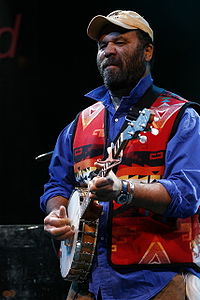
_____________________ OTIS TAYLOR continues to be one of the most fascinating people in modern music, a term twistingly appropriate in describing this traditionalist who plays "Trance Blues" on a banjo with a Jazz-Rock band accompaniment. He also performs on guitar, mandolin and harmonica, and he is a growling singer. Otis' music is truly transcendent in the way it reaches back to basic repetitions germane to early Blues to tell a simple story, often just a thought, presented in a hypnotic Jazz-Rock that sometimes veers close to what Jimi Hendrix used to accomplish with his mind-bending explorations. Otis' tunes tend to add parts as they progress - piano, horn, drums - to function as "performance pieces" more than commercial radio songs. They feel like art statements, sometimes unsettling, even scary, because Otis brings a personality that is unique in its largeness and its elegance. He doesn't give you a lot of information, and what he does tends to create, at least in me, a tension and a rare response: I'm not sure who he is but I want to hear more. Otis, who will be 61 in July, is the product of a Jazz-fan father who encouraged that form of music, though young Otis' inclinations were to play the banjo, which he only turned away from when he got the feeling that it was an instrument that had been co-opted by White minstrel players. There is another cultural artifact that shines further meaning of the Jack Hadley observation above. I wonder if White people have any analogous experience with that of the essential relationship between Black cultural memory - at least up to and including the Baby Boom generation - and the Blues? What would it be, Oklahoma? Otis Taylor dropped out of music around the time he turned 30 and launched another career as an antique salesman. By this time, he had already traveled the world playing the Blues, having long before gotten over any qualms he ever had about re-claiming the banjo as a blues instrument. Then, with the Millennium, he returned to music with a Fellowship awarded by the Sundance Film Composers' Laboratory. He was back, a rediscovered darling of the music press, awarded with Blues CD of the Year in 2002 by Downbeat Magazine Critics' Poll for Truth is Not Fiction. His song "Nasty Letter" was used in the soundtracks of two films, Public Enemies and Shooter. He won the honor from Downbeat again in 2005 for Double V, in 2007 for Definition of a Circle, and in 2008 for Recapturing the Banjo. With that last honor, the editors at Downbeat wrote "“There may not be a better roots album released this year or decade than Recapturing the Banjo.” You can learn more about Otis Taylor by going to his website. ________________________ CASSIE TAYLOR: Otis Taylor's daughter Cassie plays bass and sings in her father's band. She has a rich voice and a nice attitude that finds a particularly good vehicle in the song "Sunday Morning", which would certainly be right for every "Acoustic Sunday" radio program across the country. Go to the Otis Taylor Band MySpace and check it out. ________________________________ First published April 2009 Edition San Francisco Blues Festival
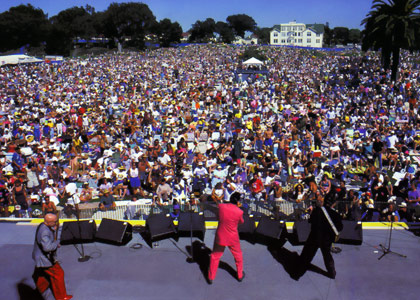
The shot at right, by Jon Sievert from the San Francisco Blues Festival web site, shows the crowds that the festival once drew to Golden Gate Park.
___________________________ by RAR In February of this year, Tom Mazzolini, producer of the longest running blues festival in the U.S. - the "San Francisco Blues Festival" - announced that there would be no 2009 event. The reason: declining attendance attributed to the dwindling number of "name artists" who could attract a crowd. The festival, which premiered in 1973, has become a money loser. In fact, it has never recovered from the "9-11" attacks of 2001, which occurred only days before that year's SF Blues Festival - a September event calibrated to the hot days of the Bay Area summer - was scheduled to begin. There is no getting around the loss not having the SF Blues Festival is to Bay Area culture, at least as it is perceived by those Baby Boomers who caught the blues bug during the revival of the late '60s and early '70s and never got over it. It was earth shaking when white kids, who had been listening to rock bands cover classic blues tunes, began to become aware of the real thing in the forms of B.B. King, Albert King, John Lee Hooker, Etta James, Bo Diddley and, of course, Robert Johnson, who became the subject of attention with the release of his seminal recordings that gave the musical genre a big part of its repertoire. The blues, like jazz and, if you wish to look at it this way, classical music, is canonized in ways that pop music is not. A musician cannot call him or her self a "blues player" unless he or she "owns" the songbook as it is owned and shared by an army of largely aging devotees. In fact, a bar band musician cannot get the respect of his or her "peers" unless he or she can sit in on classic blues tunes and know precisely what to play, whatever the key. The 6-note scale Blues is a highly refined and closely held musical thing even while being the most primitive of the "pop" music forms, on a par with "folk" in the simple purities of its basic infrastructure. There is a way to play it though, and one doesn't gain respect for near approximation. The form, to blues players, is owed more respect than that. It is that basic truth about the Blues that children of the Hippie era picked up on, probably unconsciously through the recordings of The Rolling Stones, Mike Bloomfield Band, John Mayall and the Blues Breakers, and others. Then it was made concrete by the introduction to young whites of real blues players like Buddy Guy, and the romance was on. When I was a young dude in the 1970s, you couldn't go into a bar and hear live music that wasn't the Blues. In fact, if you heard a cover band playing pop rock tunes, you could pretty much bet that you weren't among the hippest young folk in town. The Blues had caché that diminished every other form, at least "live" where it had the added advantage of selling the most alcohol. That was the thing that really solidified Blues music as a part of the Baby Boomer generation's sense of nightlife. Bar owners knew that Blues sold booze, so they kept it coming. The problems with the Blues in 2009 are that the torch never really passed from the Baby Boomers to subsequent generations. There are, to be sure, bright young lights in the Blues world, but there hasn't really been a breakthrough artist in the genre since Stevie Ray Vaughn, whose power was in his virtuosity, of course, but more than that it was in his crossover appeal. He was distinctive, a "one off" who had mastered the catalog. Beyond SRV, the Blues cadre is pretty much a cast of characters whose sounds we have all heard before, and there is the stake in the heart of the blues. It is old, yesterday's sound, a historical cultural artifact. RARWRITER.com buddy Arlic Dromgoole, who is about as good a friend as the Blues could have, has mounted quite a campaign to try to save the SF Blues Festival. He has had backstage access to the event, been close with the artists, and provided a photo library of the event's high moments. He is one of those Boomers who still feels the buzz at the sound of those authentic blues masters like last surviving Delta Blues man Honeyboy Edwards, who played the 2008 festival. Arlic encourages people to lobby for the festival's continuance. It is so obviously an asset to our "cultural lives", at least on the "low-culture" plane on which most of us reside day to day. I am not so sure that the Blues was ever really right for the kind of big event mentality that took hold of the Woodstock generation. The Blues really isn't that "big" a sound. In fact, it dwells most comfortably in the dank darkness of claustrophobic juke joints and dangerous road houses, where people reveal soulful selves best hidden by low light and the blurred vision of hard drinks. My sense is that the generation of which I am a part elevated something meant for the dark recesses into something broad and, by extension, incredibly less interesting. Blues, in the light of day, works fine as plaza entertainment, where casual observers can appreciate it in their quiet and sober ways, while a few abandoned souls dance their little tributes to an arcane form. One senses, however, that the form is withdrawing to the shadows from which it came, and where it no doubt belongs. The Blues, after all, is a deeply internal and personal thing, probably best experienced in the dark. _____________________________________
|
|
GO TO: ARTIST NEWS • YOU ARE ON A SPECIAL FEATURE PAGE
|
ARTIST NEWS THIS EDITION ABOUT MUSIC MUSIC REVIEWS BOOKS CINEMA FASHION FINE ARTS FEATURES SERIES MEDIA ESSAY RESOURCES WRITTEN ARTS POETRY CONTACT ARCHIVES MUSIC LINKS

Copyright © November, 2018 Rick Alan Rice (RARWRITER)
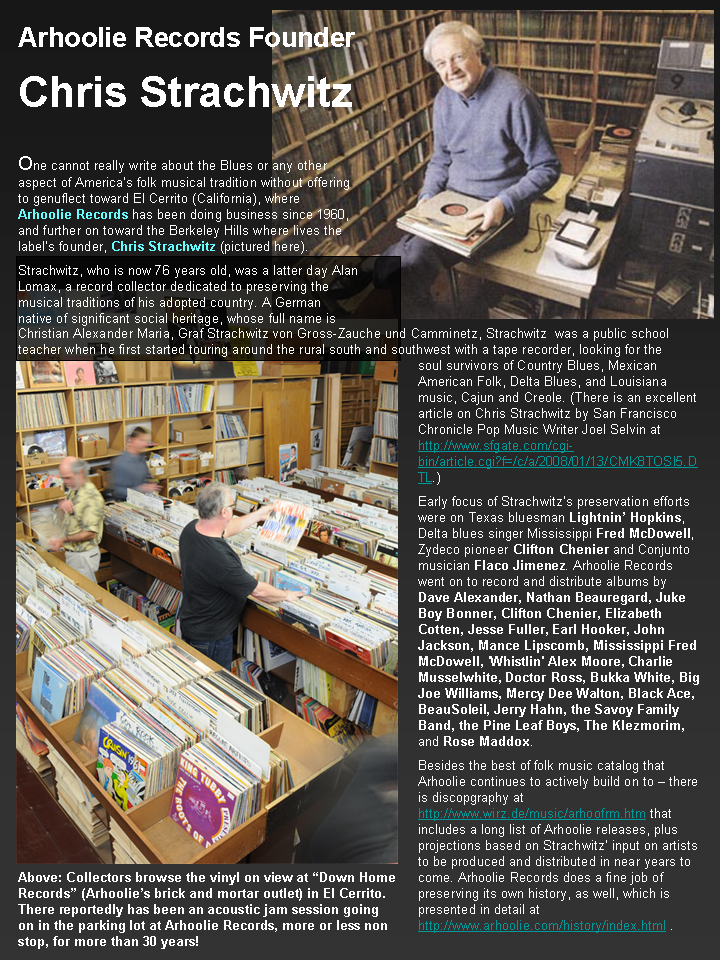 Arhoolie
Records
Arhoolie
Records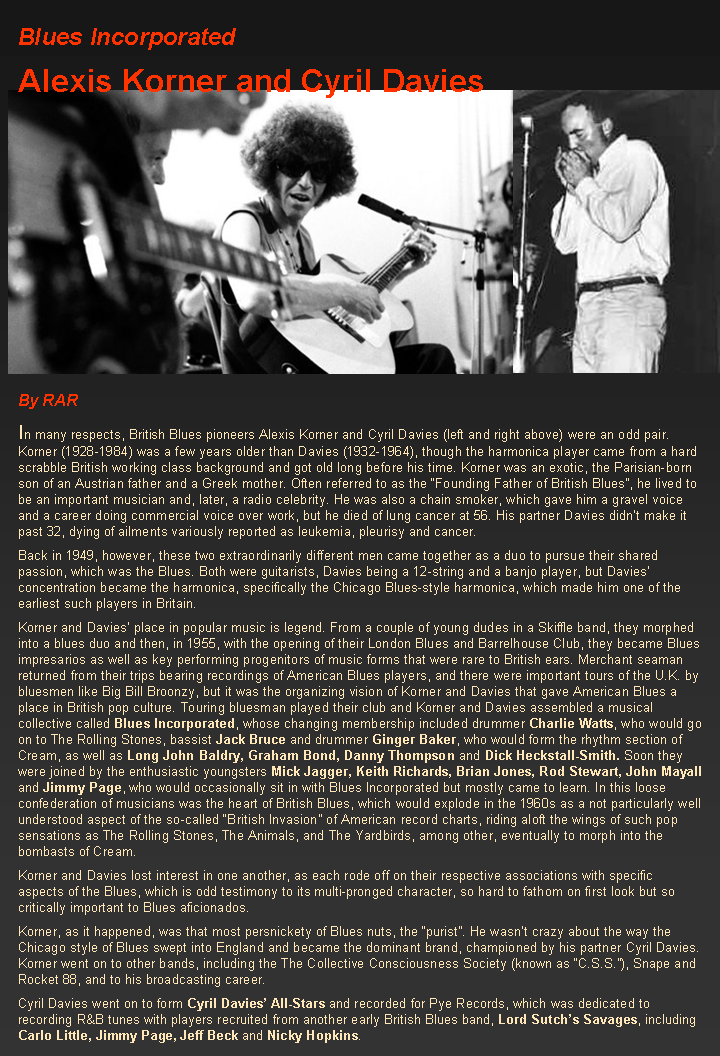 Alex
Korner and Cyril Davies
Alex
Korner and Cyril Davies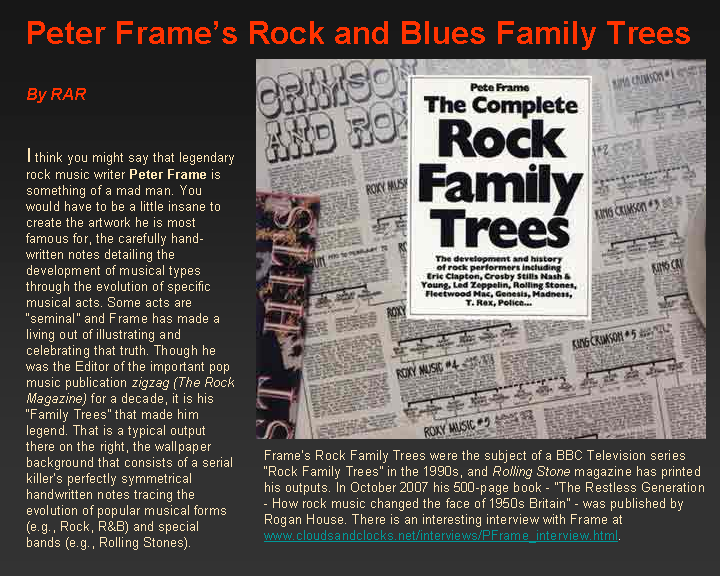 Peter
Frame
Peter
Frame