--------------------"The best source on the web for what's real in arts and entertainment" ---------------------------
Volume 1-2016
MUSIC BOOKS FINE ARTS FILM THE WORLD
|
ARTIST NEWS THIS EDITION ABOUT MUSIC MUSIC REVIEWS BOOKS CINEMA FASHION FINE ARTS FEATURES SERIES MEDIA ESSAY RESOURCES WRITTEN ARTS POETRY CONTACT ARCHIVES MUSIC LINKS |
|---|
|
SPECIAL FEATURE
On the Trail of the Late Jaco PastoriusThe following story first appeared in the June 1, 2008 edition of RARWRITER.com, and has been the subject of lively interchange between RAR and other fans of the late, great bassist.
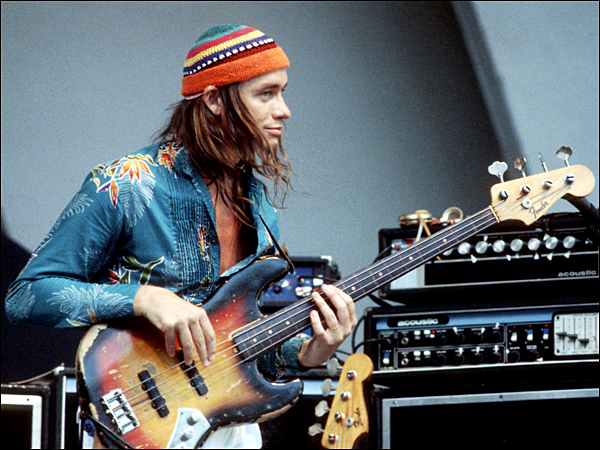
The Jaco ConnectionThe Mysterious Case of Lenny CharlesBack in the early 1980s, when I was living in Boulder, Colorado, I was occasionally visited at my apartment by a guitarist I had met through friends in the New Wave band The Pedestrians, i.e., Gerry Capone, Don Read, Phil Beckett, Steve Ignelzi, et al. The guitarist was a colorful character named Lenny Labanco, who also went by the name Lenny Charles. Lenny has been the subject of previous pieces on this site (see the Archives article "The Pedestrians Rehearsal House and Lenny Labanco"). A talented and knowledgeable guitarist - if memory serves me correctly, he was a graduate of the Guitar Institute of Technology (GIT) in L.A., and may have worked with that organization for a time before moving to Boulder - he would show up at my door with his hollow body electric in a battered case, and with his amplifier slung over his shoulder with an improvised strap that he used to haul his equipment around. I recall that he also carried a backpack, with cords and effects boxes, and general musician paraphernalia. (I recall being so impressed by this organizational approach that I assembled a similar kit of my own, based on Lenny's model.) He had the disheveled look of a vagabond musician, or maybe worse, but he always had a girlfriend in tow; one who waited on him hand and foot and acted as his "minder," or so it seemed to me. (I also recall being somewhat in awe of any guy's ability to attract such a devoted paramour, and would admit to being mystified by Lenny's "pull," because his overall presentation would not lead one to immediately understand the attraction. I think I assumed she admired his talent, which was significant.) Around this same time, I had a roommate named Stan Kirsch, another guitarist and son of a prominent Denver surgeon, who as I recall was a music student at the University of Colorado, but yearned to travel west and enroll at GIT, around which he had built an elaborate fantasy. He seemed to imagine that GIT was like the portal to music heaven, and that a degree from there was as good as a record deal. One, therefore, can imagine the gravitas Lenny Charles carried, at least in Stan's mind, via Lenny's association with the sacred place. This did not, however, prevent Stan from doing the thing Stan always did, which was to create conflict with anyone who came through the door of the apartment. He and Lenny would engage in the most ridiculous conversations imaginable about fret board technique, a subject of interest only to the most dedicated guitar students. As I recall, Stan was a "purist" and "classically" focused, dedicated to the correct angle of fingers and wrist as taught by the good folk in the CU "guitar department," if such exists. Lenny, on the other hand, was all double-stops and slurs and muted tones and...well, he was the street reality to Stan's theoretical constructs. There was no question who the better guitarist was: Lenny Charles. Lenny could cover everything from The Beatles to Weather Report to Jimi Hendrix, which brings me to the further mystery surrounding Lenny Charles. Lenny, it seems, was on his way to a rendezvous of fate, on the east coast, with another of his natural ilk, the legendary and ill-fated bassist Jaco Pastorius. Jaco Pastorius, as most readers of this site will know, was a ground-breaking bassist known for his extraordinarily melodic upper register approach to the instrument. His first recording, Jaco Pastorius (1976) was a sensation, called by some the finest bass LP of all time. The LP featured an all-star jazz band including Herbie Hancock, Wayne Shorter, David Sanborn, Lenny White, Don Alias, Michael Brecker, and even legendary R&B singers Sam & Dave. Jaco introduced himself, in his usual tactless way, to Joe Zawinul of Weather Report and joined the band. Zawinul blames himself for introducing Jaco to alcohol, not knowing that Pastorius came from a family in which alcohol had been a devastating disease. Jaco immediately became "strange," in Zawinul's words (Wikipedia). "He started throwing things. I knew right away I had made a mistake." (See reader response at the end of this story.") Though Pastorius was only in his 20s when he joined Weather Report, his demise was imminent, fueled by drug and alcohol addictions and bipolar disorder. His downward spiral was steady, but he continued to make extraordinary musical contributions. Jaco was instrumental to the brilliant songwriter Joni Mitchell, serving as her "jazz bridge" when Joni segued from her brand of sophisticated folk-rock, supported by Tom Scott and the L.A. Express with Robben Ford on guitar, to the "jazz" oriented sounds of four exceptional albums: Hejira, Don Juan's Reckless Daughter, Mingus and Shadows and Light. Joni's tours, particularly in support of the Hejira LP, were always attended by a cult-like following of Jaco Pastorius supporters, who swooned not only for his distinctive bass stylings, but for his general presentation. Jaco exuded charisma from the stage, sharing the spotlight almost as an "equal" on the bill with Mitchell. His fans adored his bohemian personal style, which extended to his sartorial preference for middle-eastern influenced clothing and knit skull caps. Jaco's mental disorders and drug dependencies culminated in one awful night in September 1987. His personal problems well known, Jaco snuck on stage at a Carlos Santana concert in Wilton Manors, Florida, and was summarily ejected from the premises. Drunk and disorderly, he showed up at the Midnight Bottle Club (now known as The Corner Pocket) in The Shoppes of Wilton Manors, was denied entrance and responded by kicking in a glass door. This initiated a fight with a club bouncer, who beat Pastorius so severely that he lapsed into a coma, lived for a brief time on life support, and then, at the behest of his family, was allowed to die. Somehow, in the midst of all that '80s awfulness, Jaco, who was often homeless during that period, became associated with the equally bohemian Lenny Charles, sometimes living on the streets with Lenny in Charles' white van. There is a piece on www.jacopastorius.com that offers some intriguing clues to the relationship between these two unique players, Jaco Pastorius and Lenny Charles, and to the final period in Jaco's life. Click here to read the blog on the Pastorius site.
READER RESPONSE TO THE JACO STORY: It is a measure of the esteem in which Jaco Pastorius is held in the bass world that the above account almost immediately resulted in a note from a Jaco admirer, who took exception to the way Jaco was portrayed in the Bill Milkowski book "Jaco: The Extraordinary And Tragic Life of Jaco Pastorius. 'The World's Greatest Bass Player" (Miller Freeman Books, 1995), which forms the basis for much of the above description of Jaco's later years. The reader wrote - "Jaco did not come from a family of alcoholics. Jaco is kind of an icon in the Jazz world and he is respected despite all the negative stuff that has been exaggerated over the years. He is a Hall of Fame Bassist. Please cut him some respect. The Bass World will love you for it. Please take the negs away. Negs were overdone in the Milkowski Book..." In fact, Jaco's second wife Ingrid and Jaco collaborator guitarist Pat Matheny both took exception to Milkowski's accounts, with Matheny quoted, in an un-attributed Wikipedia entry, as calling the book "a horribly inaccurate, botched biography." Ingrid has a site called Ingrid's Jaco Cyber Nest that endeavors to put Jaco's story into perspective. Writes Ingrid on the site - "Milkowski's delivery lacked the sensitivity of how different Jaco was. What seemed to many as being out of the norm, even unacceptable, was merely an intelligent man, pushing the limits of individuality. Jaco wore his heart on his sleeve... I believe some of his antics were purely out of frustration of being misunderstood. Clearly his actions are not common, but from my perspective, he initially only wanted to have simple fun. He lived to give of himself through his music, assuming his role as a conduit for a higher power. The alcohol and drug abuse, a form of self-medicating, which sadly happens to be the way of the world, especially in the music business, intensified the chemical imbalance he endured." Author Milkowski is a New York-based freelancer who contributes regularly to Jazz Times, Modern Drummer, Guitar Player, Bass Player, Jazziz, Audio, Pulse Guitar Club (Italy), Jazzthing (Germany) and (until its recent demise) Fi magazines. He is also the author of "Rockers, Jazzbos & Visionaries" (Billboard Books, 1999)" (from All About Jazz.com). That site states that the Milkowski book on Jaco Pastorius is "being made into a feature film by Blue Rider Pictures out of Santa Monica, California." Whether or not that movie is happening, it is a sure bet that the legend of Jaco Pastorius is not about to disappear anytime soon. - RAR
Part 3 On Jaco Pastorius:
Jaco's Wife Ingrid Weighs In
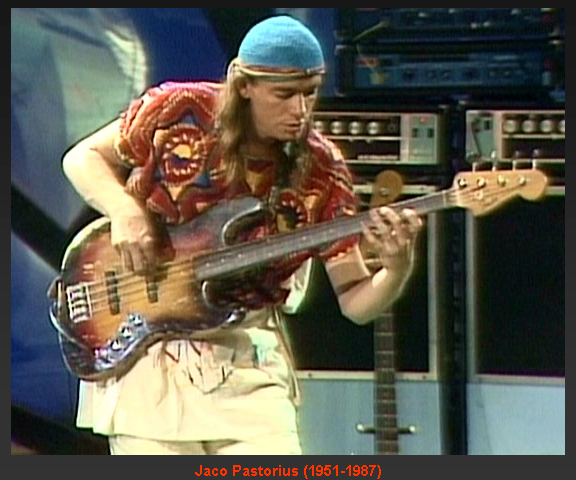
In the June 1, 2008 edition of RARWRITER.com there was a story about the late great bassist Jaco Pastorius (1951-1987), pictured above, who came to fame with the jazz fusion group Weather Report but was legend as an innovator often credited with the greatest bass LP ever produced, his 1976 self-titled effort Jaco Pastorius. RAR started down a path to explore the friendship between Jaco, who died in 1987 at the end of a late-life bout with mental disorder. Click here to read that original account. It turns out that there is a great deal of misinformation about Jaco's final years out there on the Internet, and RARWRITER.com soon heard from Jaco fans who wanted the record set straight. We also heard from Jaco's second wife, Ingrid Pastorius, who was not thrilled with RAR's reporting. Her communication, included below, is both eloquent and instructive.
____________________________________ Bass Innovator Edo Castro on Jaco Pastorius
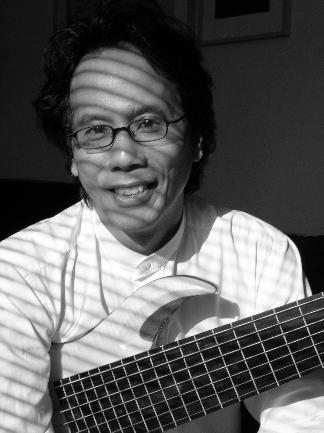
To gain further perspective into the influence that Jaco Pastorius had on subsequent generations of bass players, RAR went to San Francisco bass player extraordinaire Edo Castro (left). The ultra-articulate Edo, who in 2006 released his album Phoenix (Passion Star Records), which explored the range of rhythm and melodic possibilities presented by the instrument - Edo uses the 7-string variation - owes much to the innovative spirit of Jaco Pastorius. That said, Edo admits that talking about Jaco and the effect his playing had on him was not easy. "It actually was difficult because it's as if I were asked to describe a religious experience... words fall short and one must just be in the experience to understand it." With that introduction, here is what Edo had to say about Jaco Pastorius.
Photo by Sharon Green ________________ You know I never knew Jaco personally but I wish I had. If there was anything true to what I've read about him, he was larger than life and words didn't do him justice: You had to experience him. We were blessed to have his creative spirit, if ever so briefly in our musical lives. As most will agree he was perhaps the most influential musician of our time who single handedly changed the paradigm of the electric bass. After 20 years of his passing, there isn't a bassist out there who hasn't been influenced by his work. It's interesting because my introduction to Jaco, via recordings, didn't start with his solo album Jaco Pastorious or Heavy Weather, it was Joni Mitchell's album Hejira which came out a year before Heavy Weather (1977). I was a Joni Mitchell fan already but when this album came out my hair stood on end. Joni Mitchell took a big step with this album and I welcomed it with open arms. Track 1 on the album Hejira, "Coyote" mesmerized me. I kept wondering what "that sound was and what instrument that was making it?" I listened to that album for a year constantly to the annoyance of everyone around me. It never occurred to me that was a bass. Because up to that point I had been accustom to "thump, bumpty-bump-bump." (LOL) During that time we had Larry Graham with Sly Stone doing his slap thing, Chris Squire, John Entwistle and Rocco Prestia of Tower of Power pumping those 16th notes. Oh yeah, and Stanley Clarke's Journey to Love (1975) - that is a whole other story. Clearly though, Jaco's fretless tone and melodic approach turned everyone's head. Nobody had this sound. Anyway that was
the first time I clearly heard Jaco, not as a bassist but as a
composer, overlaying his fretless bass parts, doubling melodic
figures and creating textures using harmonics. By the time
Heavy Jaco's fretless
tone was undeniable. I mean everyone had a fretless bass by
then, scrambling to emulate his sound. Even though the fretless
bass existed prior to Jaco coming onto the scene, he definitely
popularized it. This may sound controversial but in many ways Jaco's revolution was a blessing and a curse, because in one hand he brought the bass to center stage, made bassists more accountable and raised the bar for musical competence. On the down side, many tried to play like him sacrificing the fundamental role of the bassist. The point I think most of us missed when trying to play like Jaco back then was that he had the most sublime and innate sense of groove that was way beyond all of our preconceived notions. His command of the musical language gave him a unique insight to the "other side" of the groove: partly stated, mostly implied. It's a line easily blurred and often misunderstood. Only Someone of Jaco's level could do this. His sense of the groove and time was uncanny. During that time every bass player was overplaying, trying to play like Jaco and just ruining the musical experience. There was a plethora of great and not-so-great Jaco imitators but thanks to Marcus Miller, Anthony Jackson and Stanley Clark, these guys made us remember what the bass is all about first and foremost: the Groove. For me It was a great awakening to understand that I could never be like him as a bassist but as a composer I could emulate his style and achieve the same results in my music. And perhaps that's what people hear in my music and say "wow that sounds like Jaco." That is perhaps the ultimate compliment for any bassist or composer. _______________________________ Click here to return to the Archives page.
GO TO: ARTIST NEWS • YOU ARE ON A SPECIAL FEATURES PAGE
|
|||||||
|
|
||||||||
ARTIST NEWS THIS EDITION ABOUT MUSIC MUSIC REVIEWS BOOKS CINEMA FASHION FINE ARTS FEATURES SERIES MEDIA ESSAY RESOURCES WRITTEN ARTS POETRY CONTACT ARCHIVES MUSIC LINKS

Copyright © November, 2018 Rick Alan Rice (RARWRITER)